Someone at the bar orders “two fingers of bourbon, neat,” and the bartender pours without a second thought. If you have ever wondered how much that actually is, you are not alone. Two fingers of whiskey is roughly 1.5 to 2 ounces (about 45 to 60 ml) in an ordinary rocks glass. It is not an official measure, so the real amount depends on the glass, the hand doing the measuring, and how generous the bartender feels.
This guide explains where the finger measure comes from, how it compares with a shot, a jigger and a Scottish dram, and how to pour the right amount at home. There is a simple chart further down if you just want the numbers.
Table of Contents
How much is two fingers of whiskey?
A “finger” is the depth of whiskey that matches the width of one finger laid flat against the outside of the glass, starting at the bottom. Two fingers of whiskey means filling the glass up to the top of the second finger.
In a standard rocks glass (also called an old fashioned or lowball glass), one finger works out to about three quarters of an ounce to one ounce. That puts two fingers of whiskey at roughly 1.5 to 2 ounces, or 45 to 60 ml. Most bartenders today treat the request as a normal pour of about that size.
Why the amount changes from glass to glass
- The width of the glass. A wide tumbler holds far more liquid per finger of height than a narrow tasting glass. The same two fingers can be almost double the volume in a big rocks glass.
- The size of the hand. Fingers range from slim to broad, and nobody checks.
- Flat or upright. The usual method lays the fingers flat. Holding them upright against the glass gives a much bigger pour, which is why some old stories joke about ordering “two fingers” with the fingers pointing up.
- The thick base. Many rocks glasses have a heavy glass bottom, so the first finger holds less than you expect.
In short, treat two fingers of whiskey as a friendly, approximate pour rather than a fixed amount. If you need it exact, use a jigger.
Whiskey pour sizes chart
Here is how two fingers of whiskey compares with the other words you will hear at a bar. Ounces are US fluid ounces, and the millilitre figures are rounded.
| Pour | Ounces (US) | Millilitres | Where you will hear it |
|---|---|---|---|
| Tasting pour | 0.5 to 1 oz | 15 to 30 ml | Tastings and flights, when you compare several whiskies |
| One finger | about 0.75 to 1 oz | about 22 to 30 ml | An informal, short pour |
| Pony | 1 oz | 30 ml | The small side of a double-ended jigger |
| Shot or jigger | 1.5 oz | 44 ml | The usual US bar pour |
| Two fingers | about 1.5 to 2 oz | about 45 to 60 ml | Ordering whiskey neat or on the rocks |
| UK single measure | 0.85 or 1.2 oz | 25 or 35 ml | Pubs in the UK, by law |
| Double | 3 oz | 89 ml | Two shots in one glass |
| Three fingers | about 2.25 to 3 oz | about 65 to 90 ml | A generous pour, mostly in films |
Two fingers of whiskey vs a shot
In the United States a shot is usually 1.5 ounces (44 ml). There is no single federal rule that fixes the size of a bar shot, but 1.5 ounces is the common pour and it is also the amount health agencies use for spirits. The National Institute on Alcohol Abuse and Alcoholism defines one US standard drink as 0.6 fluid ounces of pure alcohol, which is what you get in 1.5 ounces of 40% (80 proof) spirit.
So two fingers of whiskey is about the same as a shot at the small end, and a little more at the generous end. The difference is mostly in how it is served. A shot is often knocked back. Two fingers is meant to be sipped, usually from a rocks glass, neat or over ice.
How many standard drinks is two fingers of whiskey?
The answer depends on the strength of the whiskey as well as the pour. Using the NIAAA definition:
- 2 oz of whiskey at 40% ABV contains 0.8 oz of alcohol, about 1.3 standard drinks.
- 2 oz at 50% ABV (100 proof, common for bottled-in-bond bourbon) is about 1.7 standard drinks.
- 2 oz of a cask strength whisky at 60% ABV is 2 standard drinks.
That last line surprises a lot of people. A cask strength pour that looks modest in the glass carries twice the alcohol of a standard shot, which is one more reason to add a few drops of water and take your time.
What is a dram of whisky?
In Scotland and among whisky fans everywhere, “a dram” simply means a measure of whisky. It is a friendly word, not a fixed amount. You might be offered “a wee dram” after dinner, and the size depends entirely on your host.
Pubs are different. Under the Weights and Measures (Intoxicating Liquor) Order 1988, gin, rum, vodka and whisky sold by the glass in the UK must be served in set quantities. A 1994 amendment added 35 ml alongside 25 ml, so a pub single is either 25 ml or 35 ml, or multiples of those. A UK single is therefore smaller than a US shot, and smaller than two fingers of whiskey poured at home.
The word itself is old. There is a unit called the fluid dram, one eighth of a fluid ounce (about 3.55 ml), and it shares a root with the ancient Greek drachma. Nobody pours a whisky that small, though. How the unit became the everyday word for a glass of whisky is still a matter of debate.
Other whiskey words you will hear at the bar
- Neat: whiskey poured straight from the bottle at room temperature, with nothing added.
- On the rocks: poured over ice.
- Up: chilled with ice, then strained into a glass without ice. More common for cocktails than for whiskey on its own.
- With a splash: a little water or soda added. A few drops of water can open up the aroma, especially in a strong whisky.
- A back or a chaser: a separate glass of water, beer or something else served alongside.
- A double: twice the standard pour, usually 3 ounces in the US.
Put together, “two fingers of whiskey, neat, with a water back” is a clear and perfectly normal order.
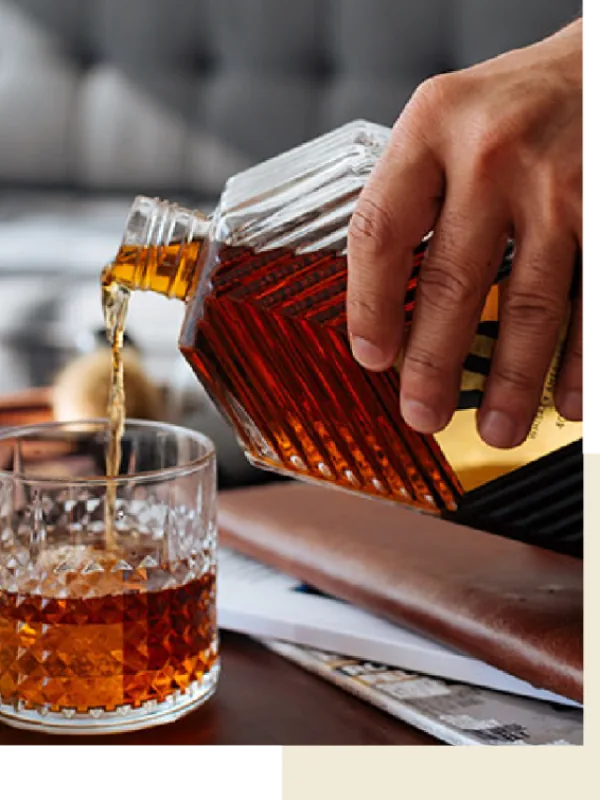
How much whiskey to pour for a tasting
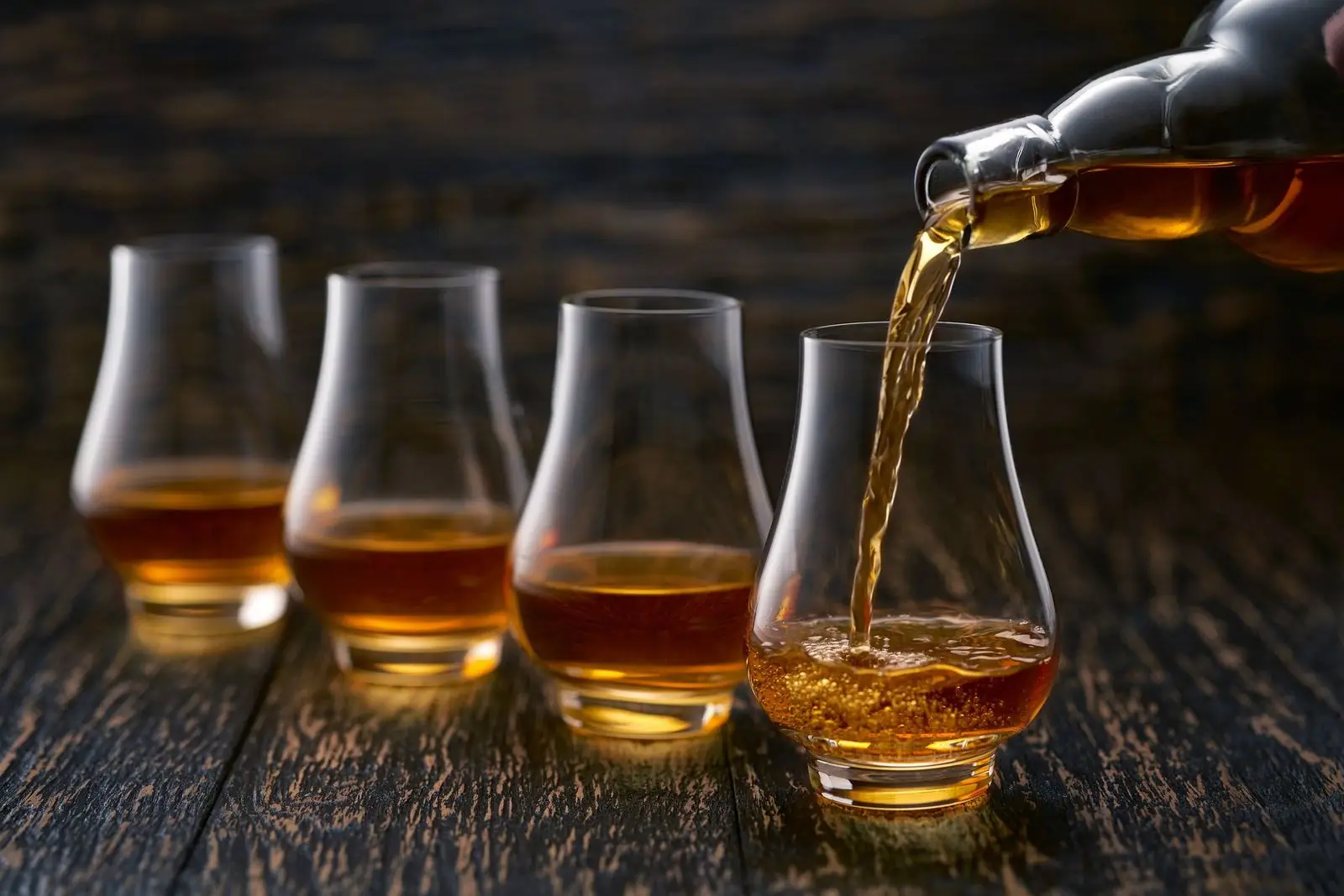
When the goal is to taste rather than to relax with a drink, smaller is better. Most tasting flights use between half an ounce and one ounce (15 to 30 ml) of each whisky. That is roughly half of two fingers of whiskey: enough to nose it, take a few sips, try it with a drop of water, and still compare four or five whiskies without your palate giving up.
The glass matters here too. A tulip-shaped glass such as a Glencairn concentrates the aroma, and a small pour leaves plenty of room above the liquid. Our guide to choosing a whisky tasting glass explains why shape makes such a difference, and whiskey tasting basics for beginners walks through what to do once it is poured.
How to pour two fingers of whiskey at home
- Pick your glass. A rocks glass for sipping, a tasting glass for comparing. Use the same glass each time so your pours stay consistent.
- Measure once. Pour 1.5 or 2 ounces with a jigger or a measuring spoon (one tablespoon is half an ounce) and notice where the whiskey comes up to.
- Check it against your fingers. Lay two fingers flat against the glass. Now you know what two fingers of whiskey means in your glass, with your hand.
- Keep the bottle in mind. For a cask strength whisky, pour a little less or add water, since the same volume carries more alcohol.
If you are planning an evening with friends, our guide on how to host a whiskey tasting at home covers pour sizes for a group, and a whiskey tasting kit takes the measuring out of it, with the samples already portioned for you. Once a bottle is open, it is also worth knowing how long an open bottle stays at its best.
Frequently asked questions
How many ounces is one finger of whiskey?
About three quarters of an ounce to one ounce (22 to 30 ml) in a standard rocks glass. In a wide tumbler it can be more, and in a narrow tasting glass it is less.
Is two fingers of whiskey a lot?
No. At 1.5 to 2 ounces it is a normal single serving, roughly one to one and a half standard drinks for a 40% whiskey. It becomes more if the whiskey is cask strength or the glass is very wide.
Is a finger of whiskey the same as a shot?
Not quite. One finger is usually a little less than a 1.5 ounce US shot, while two fingers is about a shot or a little more. The finger is also an informal measure, while a shot glass gives the same amount every time.
Do bartenders still measure in fingers?
Rarely. Bars pour with jiggers or measured pourers so that every drink is the same and the stock adds up. If you ask for two fingers of whiskey, most bartenders will give you their standard pour, which is usually 1.5 to 2 ounces.
How big is a dram?
There is no fixed size. As a friendly word it means whatever measure your host pours. In UK pubs a whisky single is 25 ml or 35 ml by law, and the old fluid dram unit is only about 3.55 ml.
The short version
Two fingers of whiskey is about 1.5 to 2 ounces in a rocks glass, close to a US shot and a little more than a UK pub single. It is a relaxed, by-eye measure, so the glass and the hand change it. For tasting, pour less; for strong whiskies, pour less still or add water. Please enjoy whiskey responsibly, and only if you are 21 or older.
Sources
- What Is a Standard Drink? National Institute on Alcohol Abuse and Alcoholism (NIAAA)
- The Weights and Measures (Intoxicating Liquor) Order 1988, legislation.gov.uk
- The Weights and Measures (Intoxicating Liquor) (Amendment) Order 1994, legislation.gov.uk
- Dram (unit), Wikipedia