The first time somebody asked me how to become a whisky taster, I gave them a long answer about regions and cask types. It was useless. They came back a fortnight later having learned nothing, because they had spent the whole time reading instead of smelling.
So here is the shorter version. You become a whisky taster by tasting, badly at first, in a structured way, and writing it down. Everything else is scaffolding.
There is still a right order to do it in, and a few things that genuinely speed it up. Here is what actually works.
What a whisky taster actually does
Less drinking than people imagine, which surprises most people who set out to become a whisky taster. A working taster is doing one of two jobs.
Describing, which means putting words to what is in the glass so somebody else can decide whether they want it. Reviewers, educators and shop buyers do this.
Judging, which means deciding whether a sample matches what it is supposed to be. Distillery and blending work is mostly this, and it involves spitting far more than swallowing.
Both rest on one skill: noticing something, then naming it accurately enough that another person recognizes it. That skill is trainable. Nobody is born with it, and you do not need a remarkable nose to become a whisky taster.
Step 1: Fix how you nose the glass
Almost everyone does this wrong, and correcting it is the fastest single improvement available.
- Use a tulip-shaped glass. A Glencairn is the standard, though any copita works. A tumbler lets everything escape before it reaches you.
- Keep your mouth open. It sounds odd and it works immediately. Far more reaches you through the retronasal route than through your nostrils alone.
- Short sniffs, glass at the chin. Do not bury your nose in it. At 40%-plus the ethanol numbs you within seconds and the next three drams are wasted.
- Nose it twice. Once neat, once after a few drops of water. The gap between those two is where most of the information lives.
We cover the mechanics in Nosing Basics, and there is a separate argument about whether swirling helps at all in To Swirl or Not to Swirl.
Step 2: Taste in pairs, never in flights
This is the advice people ignore, and then wonder why they are not getting better.
Six drams in a row teaches almost nothing. Your palate is gone by the fourth and you finish with six sets of notes that all read “oak, vanilla, nice.” Two glasses side by side, chosen so that exactly one thing differs between them, teaches you what that one thing does.
Pairs worth starting with:
- A bourbon and a rye from the same distillery. Only the grain changes.
- An ex-bourbon Speyside against an ex-sherry one. Only the wood changes.
- The same whisky neat and with water. Only dilution changes.
- A peated malt against an unpeated one. The most obvious contrast there is, and a useful calibration point.
Anyone trying to become a whisky taster on a budget should lean on this hard. Two 30ml samples teach more than a full bottle worked through alone over six months.
Step 3: Keep notes, and keep them short
Everyone who sets out to become a whisky taster writes too much at first. Long tasting notes are a trap. People write a paragraph of adjectives they only half mean, then never read it again.
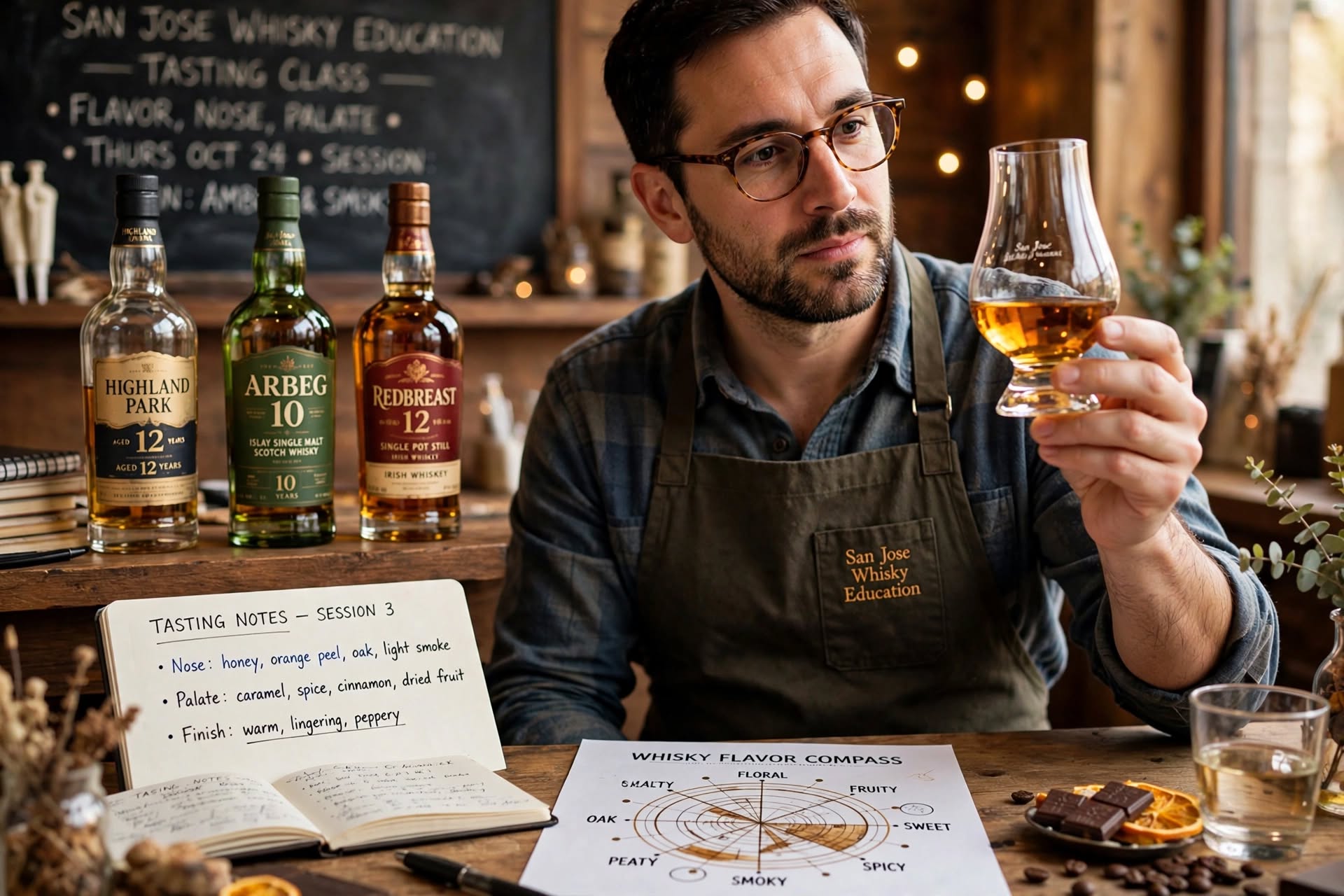
Three lines is plenty. Nose, palate, finish. One honest word beats five borrowed ones. If the only thing you can say is “sharp,” write sharp. In a month you will have a word for what kind of sharp it was.
What matters is doing it every single time. Six months of three-line notes will show you patterns you could not have predicted, usually about your own preferences rather than about the whisky. A flavor map gives you somewhere to hang the words, which is what the Whisky EDU Flavor Compass is for.
Step 4: Learn the rules behind the liquid
To become a whisky taster you do not need every distillery in Scotland memorized. You do need the handful of legal rules that explain why whole categories taste different, because then a label tells you something before you open the bottle.
Two carry most of the weight. The Scotch Whisky Regulations 2009 require three years in oak casks under 700 liters, and in practice those casks are nearly always secondhand. American rules in 27 CFR 5.143 require bourbon to go into new charred oak.
Fresh wood against tired wood. That single difference explains more about why bourbon and Scotch diverge than any tasting note will. We break the categories down in the 7 types of whiskey, and the cask side in What Is a Whiskey Barrel?
Worth knowing early: regions predict far less than people claim. We argued that out here.
Step 5: Start blind tasting sooner than feels comfortable
This is the step that separates people who become a whisky taster from people who collect bottles. Labels do a great deal of your tasting for you, and you will not believe how much until you cover them up.
You do not have to guess the distillery. Start with easier questions. Peated or not. Sherry cask or bourbon cask. Younger or older. Answering those consistently is a real skill, and it is the point at which most people stop guessing and start tasting.
Expect to be wrong constantly at first. Everyone is. The people who become a whisky taster worth listening to are simply the ones who kept going while being wrong.
Books worth owning if you want to become a whisky taster
Three books will do it. Nobody needs a library to become a whisky taster.
- Dave Broom, Whisky: The Manual. The least precious book about whisky ever written. His case for mixing good whisky with soda annoyed a lot of people, and he was right.
- Dave Broom, The World Atlas of Whisky. Distillery by distillery, with notes you can calibrate your own against. The one you keep going back to.
- Lew Bryson, Tasting Whiskey. The clearest American perspective, and strong on bourbon and rye where the Scottish books run thin.
Buy them secondhand. Nobody needs a first edition to learn what sherry influence smells like.
Qualifications: what is real, and what you cannot study for
You do not need a certificate to become a whisky taster, and plenty of excellent palates hold none. If you want to work in the trade, though, two are genuinely recognized.
WSET Award in Spirits, Levels 1 to 3. The default qualification across the drinks industry. It covers spirits broadly rather than whisky alone, and Level 2 is where most enthusiasts start.
Institute of Brewing & Distilling. Heavier on production science than on sensory work, and aimed at people who will end up inside a distillery rather than in front of a glass.
Now a correction, because this gets repeated in nearly every article about how to become a whisky taster.
Keepers of the Quaich is not a qualification. You cannot enroll in it, study for it or buy your way in. It is an honorary society that recognizes people who have already given long service to the Scotch industry, and members are nominated and then inducted at ceremonies at Blair Castle. Seeing it listed next to WSET as a course is a reliable sign the writer did not check.
How long does it take to become a whisky taster?
Honest answer, from watching people actually do it.
- Three months of paired tastings and short notes, and you will reliably separate peated from unpeated, sherry cask from bourbon cask.
- A year, and you will have preferences you can explain and defend, which is further than most drinkers ever get.
- Several years before you pick distilleries blind with any consistency, and even professionals miss.
Nobody manages it in a weekend course. What a course does is stop you wasting the first six months on bad habits.
Common questions
Do you have to swallow?
No, and professionals usually do not. Spitting is normal at any serious tasting and nobody will think twice about it. You lose a little of the finish, which is why most people take one small swallow on the final pass and spit the rest.
Can you become a whisky taster if you smoke?
Yes, though it does not help. Smoking dulls sensitivity while you are doing it rather than permanently, and smell recovers substantially after stopping. Avoid it, along with coffee and mint, for an hour or two before tasting.
How much does it cost to become a whisky taster?
Far less than people assume, provided you buy samples instead of bottles. A decent glass and a steady supply of 30ml pours will take you further than a shelf of full bottles you never finish.
Is whisky taster a real job?
Full-time sensory roles exist at distilleries and blending houses, but there are not many and they usually sit inside a production or quality team. Far more people taste as one part of a broader job: buying, writing, education, hospitality.
Does it matter whether I spell it whiskey or whisky?
Only for knowing where the bottle came from. We explained the split in Whiskey or Whisky?
Where to start this week
Pick two whiskies that differ in exactly one way. Pour both. Nose each twice, once neat and once with water. Write three lines on each. Do it again next week with a different pair.
That is the entire method. Everything above is detail, and it is genuinely all you need to become a whisky taster.
If you would rather not assemble the pairs yourself, our Whiskey Tasting Kits are built as comparisons for exactly this reason. The Monthly Whisky Study Group works through six bottles together every month with an educator, which is the quickest way to calibrate against someone more experienced. For sessions in person, see whisky classes in San Jose.
Brand new to all of it? Begin with the Whisky Tasting Guide for Beginners, then come back and start pairing.