Somebody at a tasting last month asked why the bourbon and the Scotch in front of him tasted like they came from different planets. Same grain family. Same copper. Same oak. Completely different drink.
Fair question, and the answer is mostly paperwork. The main types of whiskey are separated by law, not by taste, and once you know what each rulebook demands you can more or less predict what will be in the glass before you lift it.
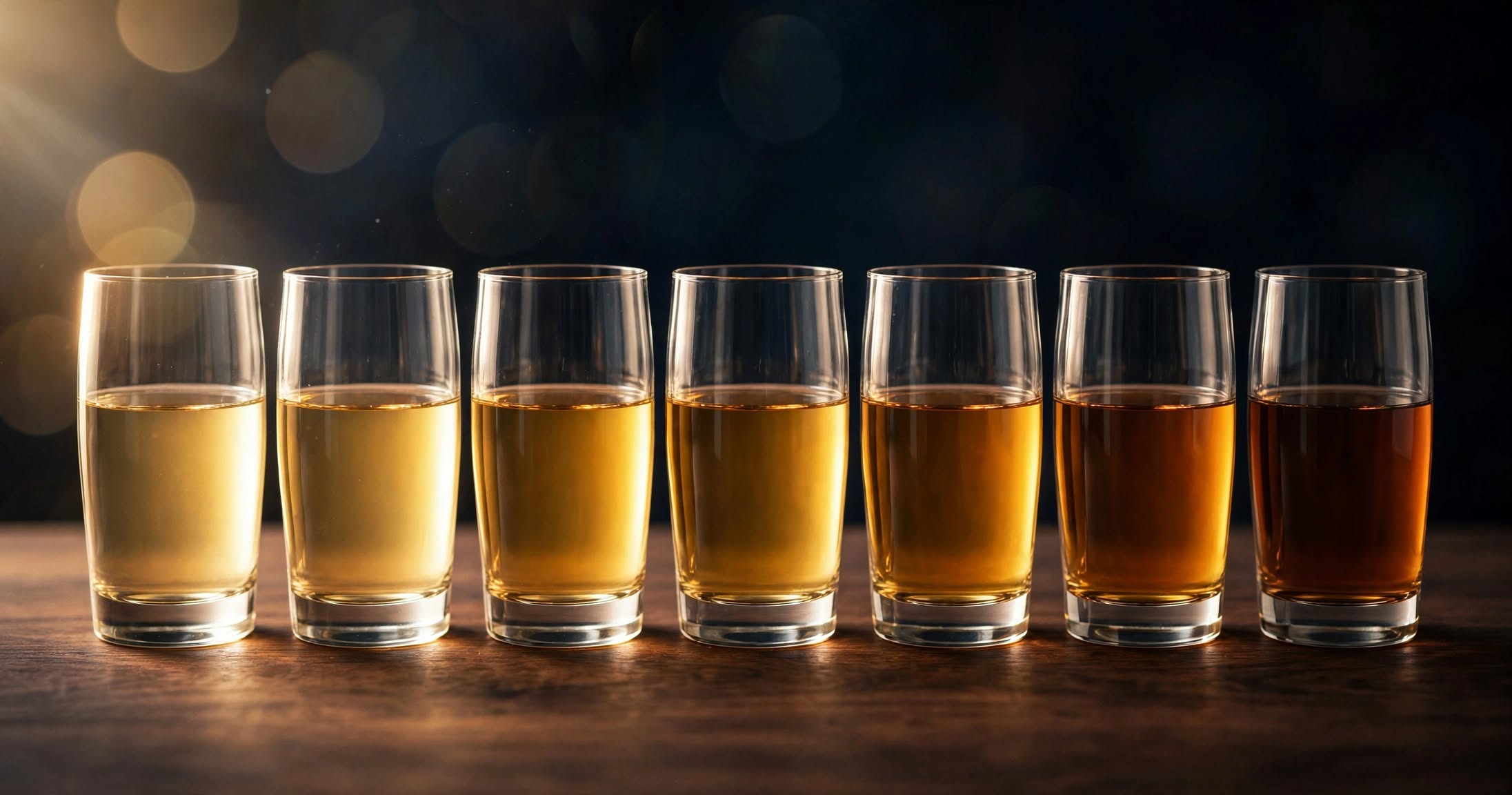
Here are the seven types of whiskey that matter, what the rules actually say, and what each one does to your palate.
The 7 types of whiskey at a glance
| Type | Where | The rule that defines it | Expect |
|---|---|---|---|
| Scotch | Scotland | 3 years min in oak casks under 700L | Dry, cereal, often smoke |
| Irish | Ireland / N. Ireland | 3 years min, made on the island | Light, soft, orchard fruit |
| Bourbon | USA, any state | 51%+ corn, new charred oak | Sweet, vanilla, caramel |
| Tennessee | Tennessee | Bourbon rules plus maple charcoal filtering | Bourbon, smoothed out |
| Rye | USA | 51%+ rye, new charred oak | Pepper, dill, dry spice |
| Canadian | Canada | 3 years min in Canada, under 700L wood | Light, blended, easy |
| Japanese | Japan | Voluntary standard since 2021 | Precise, delicate, Scotch-adjacent |
Worth saying up front: the spelling changes depending on which of these you are talking about. Scotland, Canada and Japan drop the e. Ireland and the United States keep it. We wrote about why we spell it both ways if that bothers you as much as it bothers copy editors.
1. Scotch whisky
The Scotch Whisky Regulations 2009 are unusually specific. Distilled in Scotland, matured in Scotland, in oak casks no larger than 700 liters, for a minimum of three years, bottled at no less than 40% ABV.
Of all the types of whiskey here, Scotch is the one most shaped by a rule the law never spells out: almost nobody uses new oak. Scotch goes into secondhand casks, usually ex-bourbon or ex-sherry, which have already surrendered their loudest flavors to a previous tenant. That restraint is why Scotch tends to taste of the spirit rather than the wood.
Smoke is optional, not compulsory. Most Scotch has none. If you want the long version of why two Scotches can taste nothing alike, we got into it in Why Whisky Flavor Is More Than Region.
2. Irish whiskey
Made on the island of Ireland, north or south, and matured there for at least three years. Of the seven types of whiskey on this list, it is usually the easiest first pour.
Triple distillation gets quoted as the Irish signature, and it is a real tradition, but it is not a legal requirement and plenty of Irish whiskey is distilled twice. Where it is used you get a lighter, cleaner spirit with less of the oily weight you find in Scotch.
The genuinely distinctive Irish category is single pot still, made from a mash of malted and unmalted barley. The unmalted portion gives it a thick, almost peppery texture you will not find anywhere else on this list.
3. Bourbon
This is where most of the myths live, so let us clear two of them out.
Bourbon does not have to come from Kentucky. It has to be made in the United States. Any state. Kentucky makes most of it, which is how the myth started, but New York bourbon is perfectly legal bourbon.
Bourbon has no minimum age. None at all. The two-year requirement people repeat applies to straight bourbon, which is a separate designation. Plain bourbon could legally be a week old.
What the federal rules in 27 CFR 5.143 do require: a mash of at least 51% corn, distilled at no more than 160 proof, entered into new charred oak barrels at no more than 125 proof, and bottled at 40% ABV or higher.
There is one more line in that table that almost nobody mentions. Of all the American types of whiskey, bourbon is the only one barred from using harmless coloring and flavoring additives. Rye can. Wheat whiskey can. Bourbon cannot. Whatever is in the bottle got there from corn, yeast and fresh wood.
That new charred oak is the whole personality. Fresh wood gives up vanillin and wood sugars fast, which is where the vanilla, caramel and coconut come from. More on that in What Is a Whiskey Barrel?
4. Tennessee whiskey
Technically bourbon with two extra conditions, and it is defined by state law rather than federal law. Tennessee Code § 57-2-106 requires it to be made in Tennessee and filtered through maple charcoal before it goes into the barrel.
That filtering step is the Lincoln County Process. It strips out some of the heavier congeners, which is why Tennessee whiskey usually lands softer and rounder than a bourbon of the same age. Whether you taste it as smoother or as slightly flattened is a genuine matter of preference, and at tastings the room splits almost evenly.
5. Rye whiskey
Rye is the closest of all the types of whiskey to bourbon. Same framework, one grain swapped. At least 51% rye instead of corn, new charred oak, same proof ceilings.
The swap changes everything. Rye brings pepper, dill and a dry, almost herbal bite where corn brings sweetness. Pour a bourbon and a rye from the same distillery side by side and the difference is immediate, which makes it one of the best first comparisons you can set up at home.
One trap: in Canada, people call whisky “rye” out of habit, whatever grain it was actually made from. A Canadian bottle labeled rye may contain very little.
6. Canadian whisky
The lightest of the seven types of whiskey here. Mashed, distilled and matured in Canada, aged at least three years in wooden casks under 700 liters, bottled at 40% ABV or more.
Canadian producers usually distill each grain separately and blend afterwards, rather than fermenting a mixed mash. It gives blenders enormous control and tends to produce something light and accommodating. Easy to drink, harder to get excited about, though the better bottles are a long way from the mixer fodder the category is known for.
7. Japanese whisky
This is the newest of the major types of whiskey, and here is the uncomfortable part of the story. Until 2021, Japan had no legal definition of Japanese whisky at all. Bulk spirit could be shipped in from Scotland or Canada, bottled in Japan, and sold as Japanese.
The Japan Spirits & Liqueurs Makers Association introduced labeling standards that took effect in April 2021, with full compliance required by March 2024. To use the name, the whisky must be mashed, fermented and distilled in Japan, matured in Japan for at least three years in wooden casks under 700 liters, and bottled in Japan at 40% ABV or higher.
Note the word voluntary. This is an industry agreement, not a statute, and it does not carry the force of the Scottish or American rules. Older bottles on shelves may predate it entirely. Check the label.
Where it is honestly made, Japanese whisky was built on the Scottish model and shows it, usually with more precision and less peat.
The eighth type most lists have not caught up with
On 19 January 2025, the United States added a new standard of identity: American single malt whisky. It had been argued over for the better part of a decade.
The requirements are tighter than you might expect. A mash of 100% malted barley, distilled at a single American distillery, matured only in the United States in oak casks of no more than 700 liters, with no neutral spirits and no additives beyond caramel coloring, and only if it is declared on the label.
It reads like Scotch rules written by someone who wanted them stricter. Distilleries have until January 2030 to bring older labeling into line, so expect this category to become a lot more visible over the next few years. If single malt as a concept is new to you, start with What Is Single Malt Whisky?
How to actually taste the difference
Reading about the types of whiskey will only take you so far. Here is what works in a glass.
Compare two, never six. Six pours in a row and your palate gives up by the fourth. Two side by side and the differences are obvious.
Pick pairs that isolate one variable. Bourbon against rye from the same distillery changes only the grain. Bourbon against Scotch changes the wood. Tennessee against bourbon changes one filtering step. Change one thing at a time and you learn what that thing does.
Smell before you sip, and keep your mouth open while you do it. Nose to the edge of the glass, not down in it. At 40%-plus the alcohol will flatten your sense of smell if you inhale hard.
Give it water. A few drops, then wait. Lighter styles open up quickly. Heavily sherried or high-proof bottles take longer.
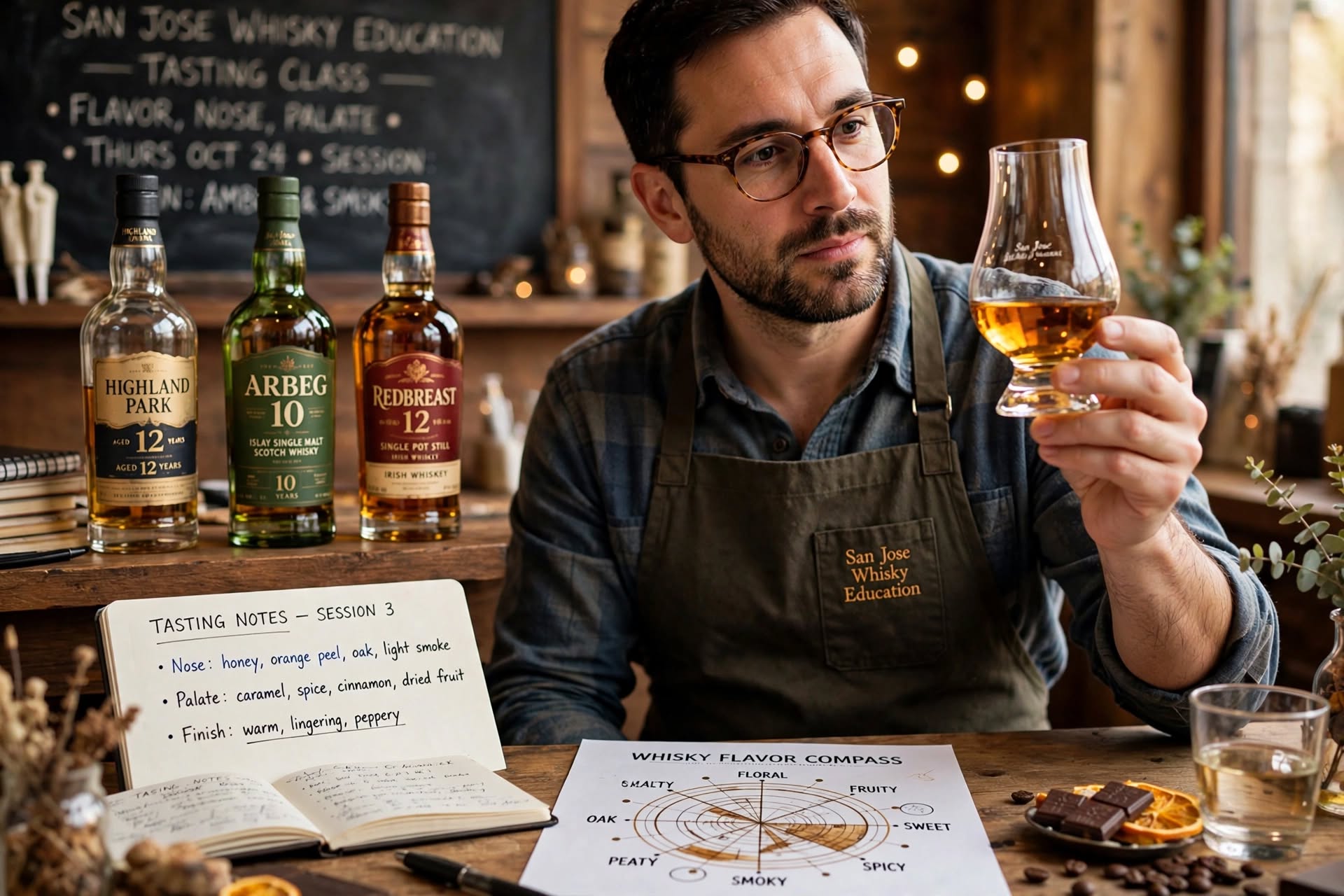
Write one word. Not a tasting note, one word. Doing that for a month builds a working vocabulary faster than anything else we have tried on students. Our Whisky EDU Flavor Compass gives you the map to hang those words on.
Common questions about the types of whiskey
Is bourbon a type of whiskey?
Yes. Bourbon is one type of whiskey, defined by American federal rules: at least 51% corn and aged in new charred oak. All bourbon is whiskey; most whiskey is not bourbon.
What is the difference between Scotch and bourbon?
Grain and wood. Bourbon is corn-led and matured in new charred oak, giving sweetness and vanilla. Scotch is barley-led and almost always matured in secondhand casks, giving a drier, more cereal-driven spirit. Scotch also carries a three-year legal minimum; bourbon has none.
Which type of whiskey is best for a beginner?
Irish whiskey or an unpeated Speyside Scotch are the gentlest entry points. Bourbon works well too if you like sweetness. Leave heavily peated Islay whisky until you have a reference point, or it will simply taste like a bonfire.
Does Tennessee whiskey count as bourbon?
It meets every federal requirement for bourbon, so legally it could be labeled that way. Tennessee producers choose their own designation instead, backed by state law and the maple charcoal filtering step.
How many types of whiskey are there really?
Seven covers what you will meet on a normal back bar. American federal regulations alone list more than a dozen designations, including wheat whiskey, malt whiskey, corn whiskey and light whiskey, plus the new American single malt category.
Put them side by side
Every one of these types of whiskey makes more sense next to another one. That is the entire reason our Whiskey Tasting Kits are built as comparisons rather than collections, and why the Monthly Whisky Study Group works through six collector series bottles together every month.
If you are starting from scratch, the Whisky Tasting Guide for Beginners is the place to begin.