Whiskey has been sold as medicine, as a nightcap and, more recently, as a heart tonic. So it is a fair question: is whiskey good for you? The short version is that whiskey is a pleasure, not a health food — and the research that once suggested otherwise has not held up well.
The short answer
No. Whiskey is not good for you in the sense of improving your health. It contains a small amount of antioxidants, but you can get far more from fruit, vegetables, tea or coffee without the alcohol. The World Health Organization’s position is that no level of alcohol consumption is safe for health. If you enjoy whiskey, drink it because you enjoy it — and drink less of it rather than more.
What is actually in a shot of whiskey?
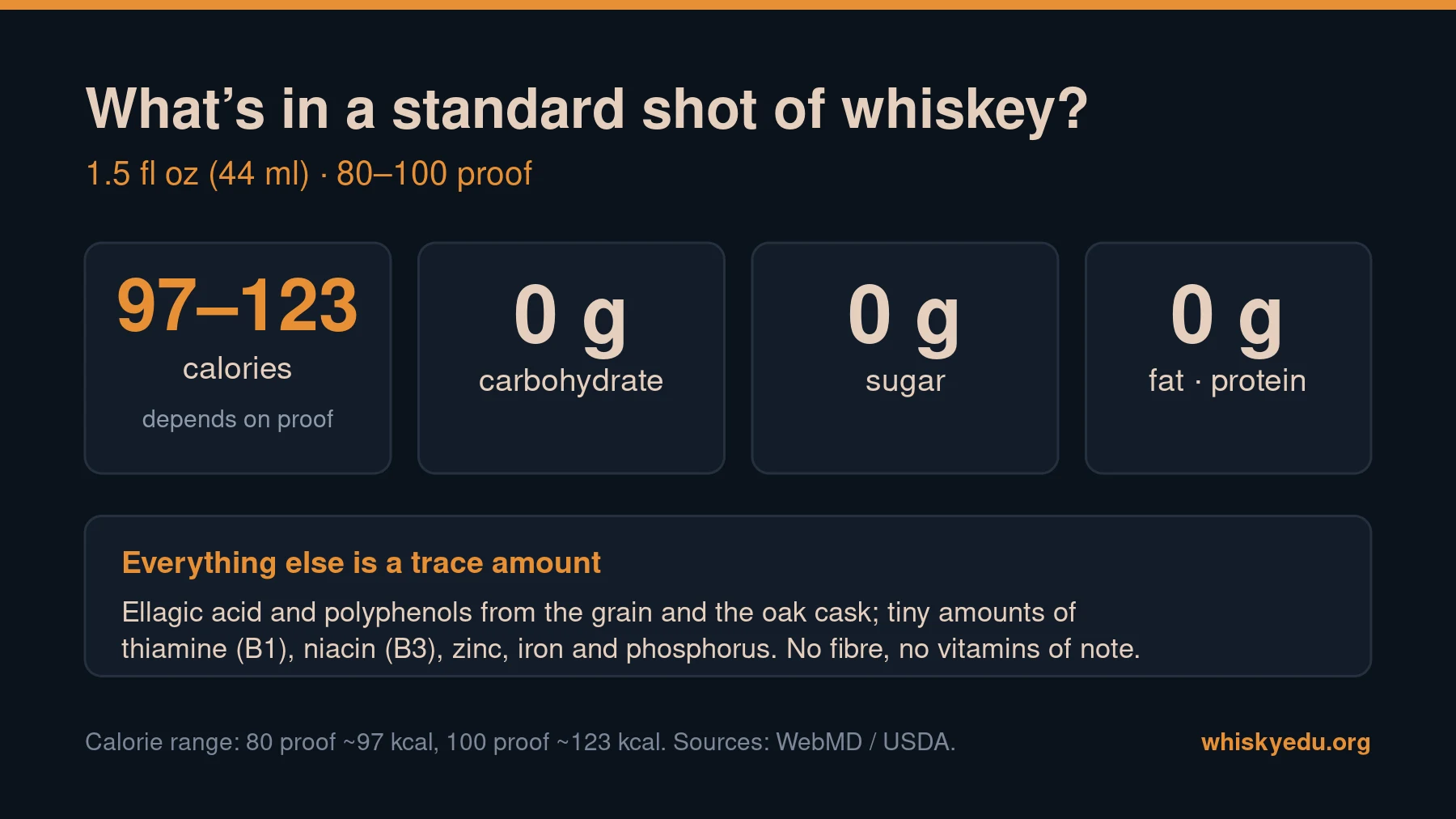
A standard shot is 1.5 fl oz (44 ml). At 80 proof that is roughly 97 calories; at 100 proof, about 123. Those calories come almost entirely from the alcohol itself — there is no carbohydrate, no sugar, no fat and no protein in a neat pour.
So is whiskey fattening? Neat whiskey has no sugar, which is why it is often called a “low-carb” drink. But alcohol carries about 7 calories per gram, close to fat, and your body burns it first — which means everything else you eat that evening is more likely to be stored. Add a sugary mixer, or the late-night food that tends to follow a few drinks, and the total climbs quickly.
Whiskey does contain ellagic acid and other polyphenols drawn from the grain and from the oak cask, plus trace amounts of thiamine, niacin, zinc, iron and phosphorus. “Trace” is the operative word: a serving of berries or a cup of green tea delivers far more, with none of the alcohol.
What one shot does in your body
Alcohol reaches your bloodstream within minutes. A rough timeline for a single standard drink:
- 0–10 minutes — alcohol passes through the stomach and small intestine into the blood. Blood vessels widen slightly, which is the warm flush people describe.
- 10–45 minutes — blood alcohol peaks. Reaction time, judgement and balance are measurably affected even below legal driving limits.
- 1 hour — the liver clears roughly one standard drink per hour. Anything faster than that stacks up in your blood.
- 3–5 hours — alcohol suppresses REM sleep. You may fall asleep faster and still wake up unrested.
The claimed benefits, and what the evidence really says
Search for whiskey and health and you will find the same handful of claims. Here is what sits behind each of them.
Antioxidants and ellagic acid
This one is real but small. Whiskey genuinely contains ellagic acid, an antioxidant also found in berries, and studies have measured a rise in blood antioxidant levels after drinking it. The problem is the comparison: blueberries, dark chocolate, green tea and leafy vegetables all deliver more, and none of them are classified as a carcinogen. Choosing whiskey as your antioxidant source does not make sense on health grounds.
Heart health and the “one a day” idea
Moderate drinking does raise HDL, the so-called good cholesterol. That single marker is what most heart-health headlines were built on. But HDL is one input among many, and the studies behind those headlines had a structural flaw that took decades to surface. That is worth its own section.
Relaxation, sleep and the nightcap
A dram genuinely does take the edge off an evening; alcohol is a sedative. But sedation is not rest. Alcohol shortens the time it takes to fall asleep and then fragments the second half of the night, cutting REM sleep. A regular nightcap tends to make sleep worse, not better, and tolerance builds quickly.
Why the old “moderate drinking is healthy” studies were wrong
For years, large studies showed a J-shaped curve: non-drinkers died at higher rates than moderate drinkers, who died at lower rates than heavy drinkers. That curve is where almost every “a glass a day is good for you” headline came from. Newer work has largely taken it apart, for four reasons.
- The sick-quitter problem. Many people who do not drink stopped because they were already ill — liver disease, heart trouble, medication that rules alcohol out. Lumping them in with lifelong abstainers made the non-drinking group look unhealthy. Exclude them properly and most of the apparent benefit disappears.
- Healthy-user bias. Moderate drinkers tend to exercise more, eat better, earn more and have better access to healthcare. The health was coming from the lifestyle, not the whiskey.
- Confounding. Income, education, social connection and stress all track with both moderate drinking and good health. Older studies rarely controlled for them well.
- Publication bias. “Wine is good for your heart” got printed. “No effect found” usually did not.
Studies using stronger methods — including genetic approaches that sidestep lifestyle confounding — find little or no protective effect. This is why major health bodies no longer advise anyone to start drinking for their health, and why we removed an older heart-disease statistic that used to appear on this page.
The risks that are well established
Where the evidence is much less ambiguous is on the harm side, particularly above moderate levels:
- Liver. Your liver processes the alcohol. Sustained heavy drinking causes fatty liver, then inflammation, then scarring that does not reverse.
- Cancer. Alcohol is a recognised carcinogen, linked to cancers of the mouth, throat, oesophagus, liver, colon and breast. Risk begins at low intake and rises with volume.
- Blood pressure and heart. The same drink that nudges HDL up also raises blood pressure and triglycerides as intake increases.
- Brain and mood. Heavy use is linked to memory problems, cognitive decline, depression, anxiety and dependence.
- Dependence. Tolerance builds quietly. A daily habit is much easier to form than to break.
- Interactions. Alcohol interferes with a long list of common medicines, including paracetamol, blood thinners, sedatives and some antibiotics.
So how much is “moderate”?
US guidance defines moderate drinking as up to one drink a day for women and up to two for men, on days when you drink. A standard drink of spirits is 1.5 fl oz at 80 proof — 14 grams of pure alcohol. The catch is that almost nobody pours that at home.
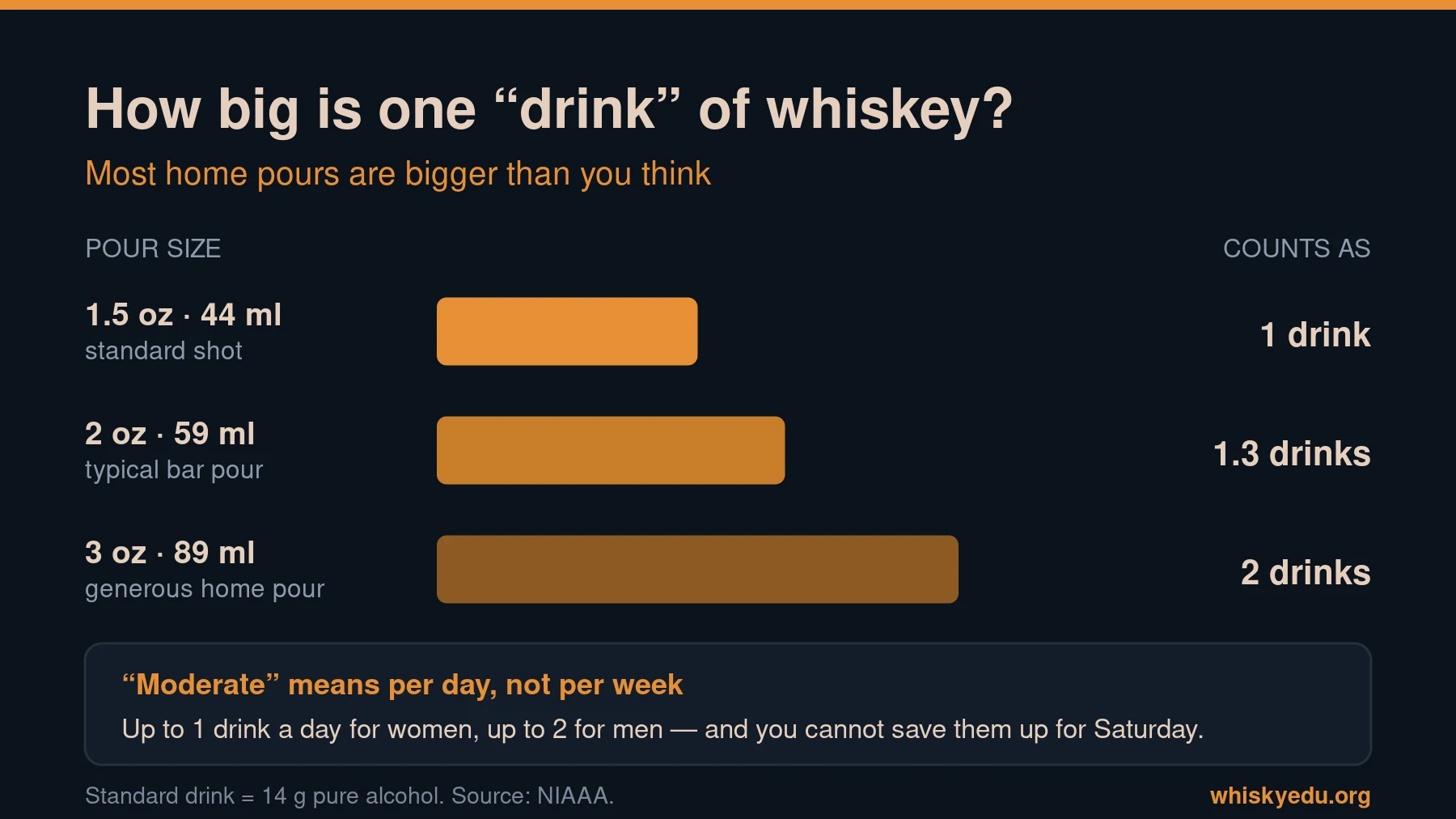
This is why “is one shot of whiskey a day bad for you?” is harder to answer than it sounds. One genuine 1.5 oz pour sits inside the guidance for men and at the limit for women. A 3 oz pour in a heavy tumbler — which is what most people mean by “a glass” — is already two drinks. Measure once with a jigger and you may be surprised.
The other rule people miss: the allowance is per day, not per week. Seven drinks on Saturday is not the same as one a day. Binge drinking carries its own distinct risks regardless of your weekly average.
Who should not drink whiskey at all
- Anyone who is pregnant or trying to conceive — no amount has been shown to be safe.
- Anyone under the legal drinking age.
- People with liver disease, pancreatitis or a history of alcohol dependence.
- People taking medication that interacts with alcohol — check with a pharmacist, not a blog.
- Anyone who is about to drive, cycle, swim or operate machinery.
The bottom line
If you already enjoy whiskey in genuinely modest amounts, that is a personal choice and a reasonable one. If you do not drink, there is no health reason to start. And if you are looking for a reason to justify the pour, that is worth noticing in itself.
Our own view, as people who teach whiskey for a living: the honest reason to drink whiskey is that it is interesting. Learning to taste properly tends to make people drink less and pay attention more — a smaller pour, sipped slowly, with some idea of what you are looking for. That is a better relationship with the spirit than any antioxidant claim.
Drink less, taste more
If you are going to pour a dram, make it one worth paying attention to. Our beginner’s tasting guide walks through a simple four-step method, the Whisky EDU Flavor Compass helps you work out what you actually like, and a proper tasting glass makes more difference than most people expect. Tasting kits and glassware are in the Whisky EDU shop.
Frequently asked questions
Is whiskey fattening?
A 1.5 oz shot is about 97–123 calories with no sugar, carbohydrate or fat. It is not fattening in the way a sugary drink is, but alcohol calories still count, your body burns them before anything else, and mixers and late-night snacking usually add more than the whiskey does.
Is one shot of whiskey a day bad for you?
One genuine 1.5 oz shot a day sits within US moderate-drinking guidance for men and at the daily limit for women. It is unlikely to cause measurable harm for most healthy adults, but it is not doing you any good either, and a typical home pour is closer to two drinks than one.
Is whiskey better for you than beer or wine?
No. What matters is the amount of pure alcohol, not the form it arrives in. Neat whiskey has no sugar or carbohydrate, which some people prefer, but a standard drink of whiskey, wine and beer all contain about the same 14 grams of alcohol.
Does whiskey have any vitamins or nutrients?
Only in trace amounts — small quantities of thiamine, niacin, zinc, iron and phosphorus, plus antioxidants such as ellagic acid from the grain and the cask. None of it is present in a quantity that contributes meaningfully to your diet.
Can whiskey help me sleep?
It will help you fall asleep faster and sleep worse. Alcohol suppresses REM sleep and fragments the second half of the night, which is why a nightcap often leaves you tired the next day.
Does whiskey help with a cold?
A hot toddy can feel soothing, and alcohol briefly widens blood vessels, which may ease congestion for a while. It does not shorten a cold, and it works against hydration and sleep — the two things that actually help.
Is whiskey bad for your liver?
In moderate amounts, a healthy liver processes it without lasting damage. Sustained heavy drinking is a different matter: it causes fatty liver, then inflammation, then irreversible scarring. If you already have liver problems, no amount is advisable.
Does whiskey prevent heart disease?
The research once suggested it might. Better-designed studies have since shown that most of that apparent benefit came from flaws in how non-drinkers were classified. No major health body recommends drinking for heart health.
Sources
- World Health Organization — no level of alcohol consumption is safe for our health
- NIAAA — what is a standard drink?
- National Cancer Institute — alcohol and cancer risk
- WebMD — whiskey nutrition, benefits and risks (medically reviewed)
This article is general information about whiskey and health, written by the whiskey educators at Whisky EDU. It is not medical advice and it is not a substitute for talking to a doctor or pharmacist about your own situation, your medication or your drinking. If you are worried about your relationship with alcohol, speak to a healthcare professional.