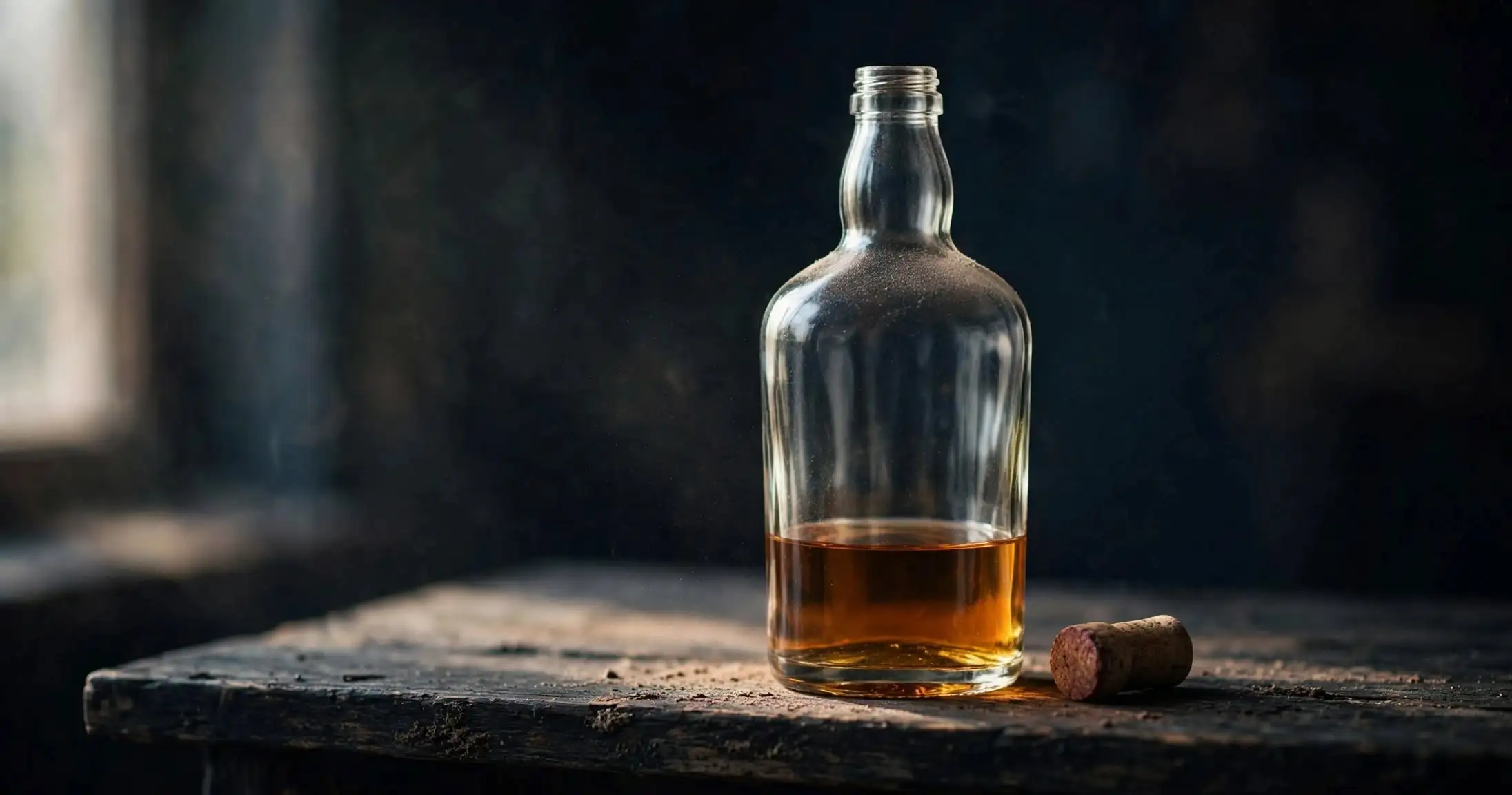
Somebody emailed us last month about a bottle of Scotch his father had opened in 2009 and never finished. Half gone, cork still in, sat on a shelf for sixteen years. His question was the one everybody asks eventually: does whiskey expire, and is this stuff still safe?
Does whiskey expire? Safe, yes. Good, probably not. And the difference between those two answers is the whole subject.
Does whiskey expire? The short answer
No. Whiskey does not expire the way food does. It will not spoil, grow anything, or make you ill.
That comes down to strength. Whiskey is bottled at a minimum of 40% alcohol by volume, a figure written into both the Scotch Whisky Regulations 2009 and the American standard in 27 CFR 5.143. Nothing microbial survives in that. There is no expiry date on the label because there is nothing to expire.
What whiskey does do is change. Slowly while sealed, faster once opened. People who ask does whiskey expire are usually noticing that change and reaching for the nearest word.
Does whiskey expire if the bottle is still sealed?
Does whiskey expire while sealed? Effectively never, provided it has been kept upright, cool and out of the light. An unopened bottle from the 1970s is still perfectly drinkable today, and people pay a great deal for exactly that.
Here is the part that surprises people, though.
Whiskey does not get older in the bottle
Wine develops in glass. Whiskey does not. Maturation happens only while the spirit is in contact with oak, which is why the Scottish regulations specify casks and a minimum of three years, not shelves.
A 12-year-old bottled in 1998 is still a 12-year-old whisky today. It is an older bottle of 12-year-old whisky, which is a different thing and worth knowing before you pay a premium for one.
We explain where the real aging happens in What Is a Whiskey Barrel?
The two things that will ruin a sealed bottle
- Lying it on its side. This is the mistake wine drinkers make. Whiskey at 40%-plus will eat a natural cork from the inside, and once the seal fails you get evaporation, cork taint and bits floating in the liquid. Always store whiskey standing up.
- Light and heat. Direct sun fades the color and flattens the aroma. A warm cupboard above a stove will push whiskey through the cork over the years. Cool, dark, stable.
There is more detail on collection conditions in our guide to how to store whisky.
Does whiskey expire once you open it?
This is where the real answer lives. Once air gets in, oxidation starts, and the whisky slowly becomes a duller version of itself.
The thing almost nobody realizes: it is not about how long the bottle has been open. It is about how much air is in it.
A bottle opened five years ago and still nearly full will taste better than one opened last year and down to the last inch. The air in the headspace is doing the work, and the more of it there is relative to the liquid, the faster it happens.
| How full the bottle is | Roughly how long before it noticeably drops off |
|---|---|
| Full to the neck | Several years |
| About three quarters | One to two years |
| About half | Six months to a year |
| A quarter or less | A few months, so drink it |
Treat those as rough guides rather than deadlines. A heavily sherried, high-strength malt holds up far longer than a light 40% blend, and cask strength bottles are the most forgiving of all.
How to tell if your whiskey has gone flat
When people ask does whiskey expire, this is usually what they have noticed. Oxidation is not dramatic. Nothing turns cloudy or smells of vinegar. It just quietly loses interest.
- The nose goes first. You lift the glass and there is noticeably less there than you remember.
- Wet cardboard or damp paper. The classic marker of heavy oxidation.
- The finish disappears. It arrives, it is fine, and then it is just gone.
- Everything flattens toward sweet. The edges, the spice, the smoke all soften into something vaguely sugary.
None of that is unsafe. It is still whiskey, and it is still fine in a highball or a cocktail. It has simply stopped being worth sipping neat.
If you are not sure whether the bottle changed or your palate did, this is a good moment to taste it against something fresh. Comparison is the only reliable test, which is the principle behind the Whisky EDU Flavor Compass.
Four ways to slow it down
- Decant into a smaller bottle. The single most effective thing you can do. Move the last third into a 200ml bottle and you have reset the air ratio almost completely. Cheap glass bottles cost a couple of dollars.
- Wrap the cork with parafilm. Stops the slow evaporation that empties bottles over years and keeps a tired cork sealed.
- Use inert gas. A spray of argon or nitrogen sits on the surface and displaces the oxygen. The same products wine drinkers use work perfectly well.
- Keep it upright, cool and dark. Still the cheapest advice, still the most ignored.
What does not work: putting it in the fridge, which mutes aroma without stopping oxidation, and topping up with another whisky, which gives you a blend nobody asked for.
What about the cork itself?
Cork failure is the one way whiskey does expire in practice. Corks dry out over decades and lose their grip, which is how old bottles end up half evaporated. You will sometimes read that you should lay a bottle down briefly, or tip it once a year, to wet the cork.
Collectors do this. It is genuinely contested, because the same alcohol that moistens the cork is also what degrades it, and a few seconds of contact is a fine line to walk. If you try it, seconds, not minutes, and never leave a bottle resting on its side.
For a bottle you actually intend to drink within a year or two, ignore all of this. Stand it up and forget about it.
Does whiskey expire differently by type?
Does whiskey expire faster in some styles? Not in any way that changes the rules, but strength and style do affect how fast you notice.
- Cask strength bottles at 55% or more hold up longest. More alcohol, slower oxidation.
- Heavily sherried or peated malts have so much going on that losing a little hurts less.
- Light, delicate whiskies at 40% show it soonest. There is less there to lose.
- Liqueurs and cream-based bottles are different. Those contain dairy or sugar and genuinely do spoil. Check the label and refrigerate after opening.
That last point matters. A cream liqueur is not whiskey in this sense, whatever the bottle says on the front. The 7 types of whiskey covers where the real category lines sit.
Common questions
Does whiskey expire after opening?
It does not become unsafe, but it loses aroma and finish through oxidation. How fast depends on how much air is in the bottle rather than how many months have passed.
Does whiskey expire into something harmful?
No. At 40% ABV and above nothing can live in it. The only real risk comes from a failed seal letting contamination in, which you would see and smell immediately.
Why does whiskey expire with no date on the label?
Because spirits above 10% ABV are not required to carry one, and in whiskey’s case there would be nothing to put there. Any date printed on a whiskey bottle is a bottling date or a batch code.
Does whiskey expire faster in a decanter?
Usually yes. Most decanters seal poorly compared with a cork, and the wide shape means more surface area touching air. Lovely on a sideboard, bad for anything you want to keep.
Is a 30-year-old bottle of 12-year-old whisky now 42 years old?
No, and this is the most common misunderstanding in whiskey. The age statement refers to time in the cask. Thirty years in glass adds nothing.
So what should you do with that half-empty bottle?
Drink it. That is the honest answer to does whiskey expire, and it is the one most people need to hear.
Whiskey kept for a special occasion that never arrives quietly turns into something less good than it was. Open bottles are for drinking, and a bottle at its best next month is worth more than a bottle you are saving.
If the honest problem is that you own one bottle and have nothing to compare it against, that is exactly what our Whiskey Tasting Kits are for. Small pours, several styles, nothing left sitting open for years. The Monthly Whisky Study Group works the same way with six bottles a month.
New to all this? Start with the Whisky Tasting Guide for Beginners.